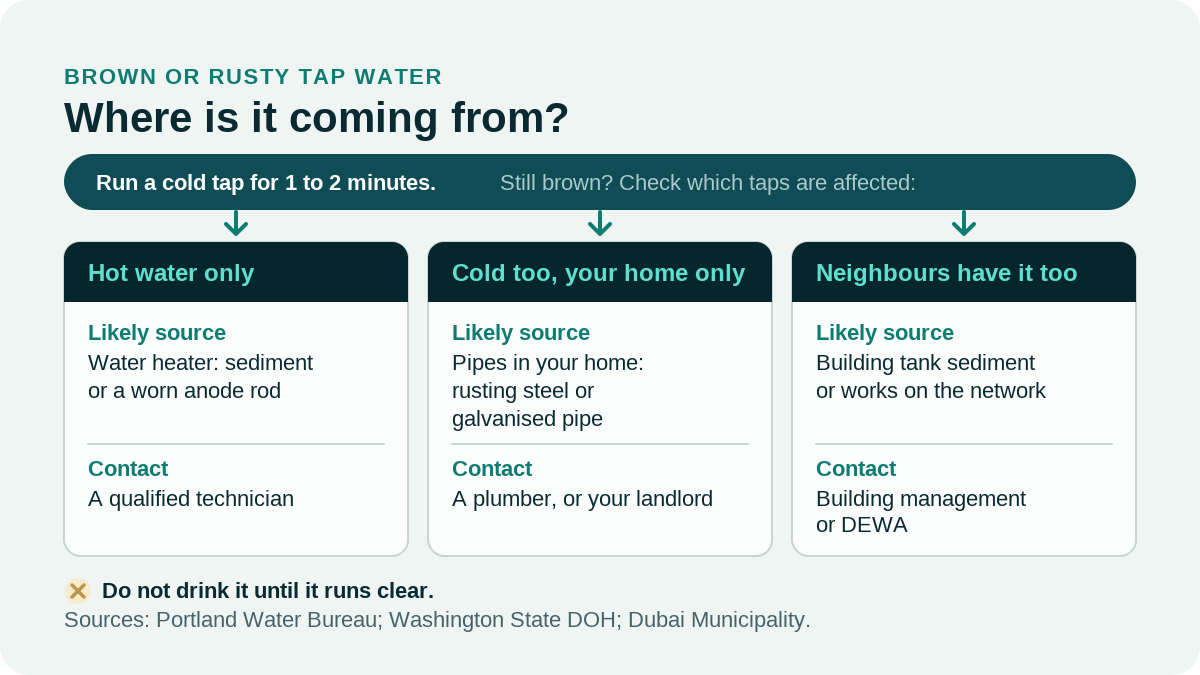
What the colour usually means
Washington State's Department of Health gives a plain rule of thumb. Brown, red, orange or yellow water is "usually caused by iron rust", and galvanised iron, steel or cast iron pipes in a building, or the water main, can cause it. Black or dark brown water is often manganese or pipe sediment.
The US EPA lists the effects of iron above 0.3 mg/L as "rusty color; sediment; metallic taste; reddish or orange staining". That figure is a non-enforceable guide for appearance and taste, not a health limit.
For Dubai's supply, DEWA publishes a typical iron figure of 0.0144 against its own specification of no more than 0.3 (a 2023 average at the network, as published). In other words, the supplied water carries little iron. Rusty water at your tap more often points to something after the meter, though a disturbance in the mains can also stir up sediment.
Common causes in Dubai homes
Corroding pipes
Galvanised iron, steel and cast iron pipes can rust and release rust into the water. Dubai Municipality's guideline for building water lists reducing corrosion of pipes and tanks among its aims, and asks buildings to prevent galvanic corrosion by avoiding contact between different metals. If brown water comes from your cold taps and only your home is affected, the pipework inside the home is the first suspect.
The water heater: brown water from the hot tap only
If only the hot water is discoloured, the City of Portland's water bureau says the colour "is likely from your water heater or pipes", and that sometimes "color is from sediment inside the tank that has been temporarily stirred up". The City of Miramar, Florida, points to rust or sediment inside the heater and suggests replacing the anode rod if it is badly worn. For buildings, Dubai Municipality's guideline requires water heaters to be kept clean and drained and disinfected at least twice a year.
Sediment in the building tank
Sediment can collect at the bottom of a building's water tank. Dubai Municipality requires tanks to be emptied, cleaned and disinfected at least twice a year. If several flats have brown water at once, the tank is worth asking about; see water tanks: cleaning and filtration.
Works on the network or in the building
Washington State's fact sheet notes that a sudden colour change often means something disturbed the flow in the main, such as a line break or firefighting. Portland adds that discoloured water is usually temporary and should clear "in a few hours or less".
After time away
Dubai Municipality asks buildings to run all taps and showers for several minutes at least weekly when rooms are unoccupied, and always before occupation. The same habit makes sense after a long holiday.
What to do first
- Stop drinking and cooking with it until it runs clear. Washington State's health department does not recommend drinking water that looks, smells or tastes objectionable.
- Run a cold tap for one to two minutes, as Portland suggests. If dark water does not clear, Washington State advises waiting about an hour and trying again.
- Compare hot and cold. Hot only points to the water heater. Both point to the pipes, the tank or the supply.
- Check other taps and a neighbour. One tap suggests that tap's pipe. The whole home suggests your pipework. Neighbours too suggests the building tank or the network.
- Hold the laundry. Rusty water can stain clothes and fixtures.
- Contact the right people. In an apartment, tell building management: Dubai Municipality makes the building owner responsible for water quality in the building until it reaches users. In a villa, the pipes and tank after the meter are yours. If you suspect the network, DEWA lists 04 601 9999 for general enquiries, 991 (24 hours) for electricity and water technical notifications, and [email protected].
When it is a safety question
Washington State says iron in drinking water "is not a human health concern", and Portland says the same. Both add caveats: Washington State warns that a sudden change of colour could indicate a public health concern, because a break or plumbing fault may have let unsafe water into the line, and Portland notes that copper and higher manganese levels can be a health concern.
Treat it as a safety question when the change is sudden, when it does not clear after flushing, when it smells or tastes of fuel or chemicals, or when the whole building is affected. Stop using the water for drinking, report it, and if you need to know what is in it, use an accredited laboratory. Our guide on water testing: lab, home kit or home visit explains which test answers which question.
What treatment can and cannot do
- A sediment filter traps rust flakes and grit before they reach taps and appliances. It does not stop the pipes rusting, and it clogs faster while the source remains. See sediment filters.
- An iron water filter is a different thing. Penn State Extension describes oxidising filters, usually manganese greensand or birm, that "both oxidize and filter iron and manganese in one unit" and need regular backwashing. They are built for dissolved iron, typically in well water. Penn State advises testing first, because the amount and form of the iron decide the treatment. On DEWA's published figure, dissolved iron in Dubai's supply is low, so rust particles from pipes are the more likely problem.
- Fixing the source is the lasting answer: replacing corroded pipe sections, servicing the water heater, cleaning the tank. In a villa, a sediment stage at the inlet can protect the whole house meanwhile; see whole-house water filtration.
Flushing a water heater: the general idea
A guide from the US Department of Energy's Building America Solution Center explains that sediment collects in water heater tanks over time. Flushing means switching off the power, closing the cold inlet, draining the tank through the drain valve, and refilling it completely before the power goes back on. The guide warns that the water coming out will be hot and that a heater which switches on empty can be quickly damaged. Afterwards the water may stay cloudy for hours.
Follow the manual for your heater, and use a qualified technician, particularly for anything involving the anode rod or electrics. In an apartment, ask building management first.
Next step
If the water has cleared but you want to know what reaches your taps, book a free water test. We measure hardness, TDS, disinfectant residual and pH at your taps, look at the tank and inlet, and give you the results in writing. It is an on-site test, not a laboratory analysis. Appointments are taken at least 10 days ahead.
Find out what is in your water
The free test measures hardness, TDS, disinfectant residual and pH at your own taps. We supply, install and maintain water treatment systems in every area of Dubai; message us for prices and service details.