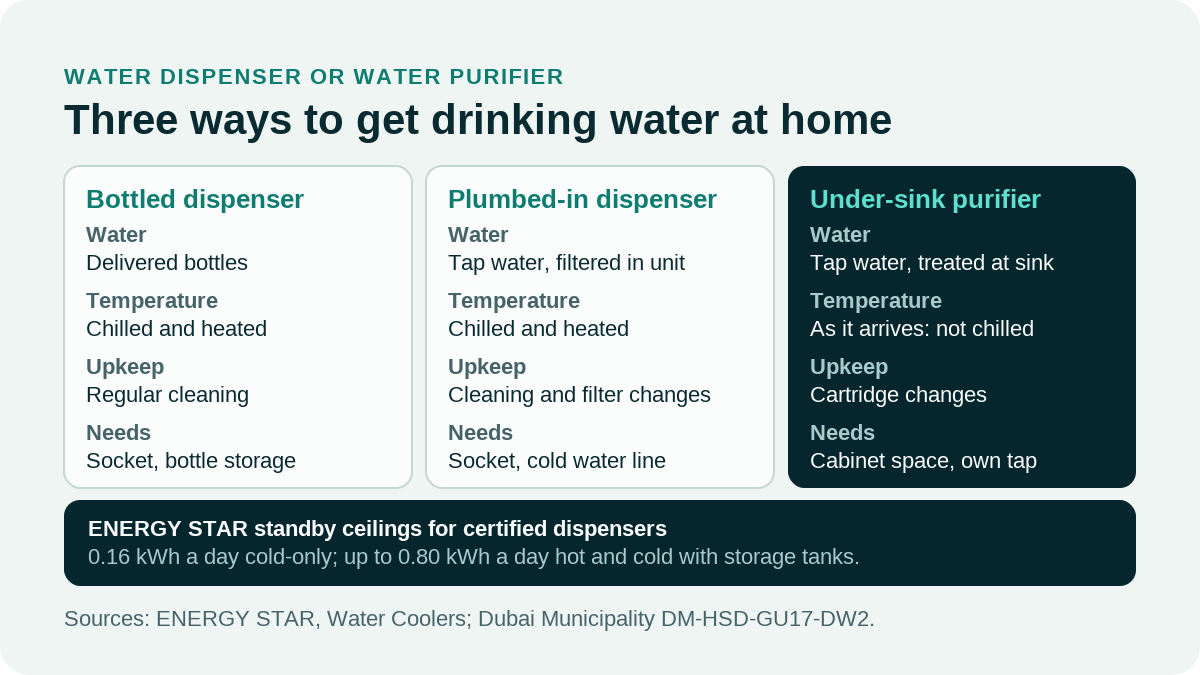
The three kinds of water dispenser
Top-load bottled dispenser. The familiar water cooler: a large bottle sits upside down on top. The US ENERGY STAR programme describes bottled units as using "standard 3 or 5 gallon bottles". A 5-gallon bottle is about 18.9 litres, so someone has to lift roughly 19 kg of water onto the machine at each change.
Bottom-load water dispenser. The same machine with the bottle standing in a cabinet at the base and a pump lifting the water. Nothing is lifted above waist height, and the bottle is out of sight.
Plumbed-in filtered water dispenser. Also called a point-of-use, bottleless or tap water dispenser. ENERGY STAR describes these as units that connect to the cold water line and refill automatically, and notes that they usually need a plumber to install. Filters inside the unit treat the tap water: the programme mentions activated carbon systems and reverse osmosis systems, and says both need periodic filter changes. A water cooler with RO is this kind of machine.
Counter top water dispensers exist in both bottled and plumbed-in forms. ENERGY STAR notes that countertop units are smaller and often have a smaller compressor, so the water may not be as cold.
Hot, cold and ambient: what a purifier can and cannot give you
A hot and cold water dispenser keeps water in small internal tanks, one chilled and one heated, or heats it on demand.
An under-sink drinking water system treats water and nothing more. No filter stage changes temperature: sediment, carbon, a reverse osmosis membrane and a remineralisation stage all deliver water at the temperature it arrives. In a Dubai summer the cold line can run warm, so purified water can come out warm too.
That leaves three honest options if you want purified water cold:
- Fill a clean, covered jug from the purifier's tap and keep it in the fridge.
- Use a dispenser that is fed with purified water.
- Choose a plumbed-in dispenser with its own filters and accept its filter changes and cleaning.
What each costs to run per year
We do not publish dispenser prices or bottled water prices: we do not sell either, and prices change. A bottled dispenser costs you bottles and electricity. A plumbed-in dispenser costs tap water, electricity and filter cartridges. A purifier costs tap water and cartridges.
Bottles. This is the cost that repeats with every delivery. Our bottled water vs home purifier calculator works it out from the number of bottles you use and the price you pay.
Electricity. A dispenser draws power all day to hold water hot and cold, whether or not anyone uses it. ENERGY STAR sets ceilings for that standby use, measured with no water drawn, for the models it certifies:
| Type | ENERGY STAR ceiling, standby |
|---|---|
| Cold only, or room temperature and cold | 0.16 kWh a day |
| Hot and cold, storage tanks, low capacity | 0.68 kWh a day |
| Hot and cold, storage tanks, high capacity | 0.80 kWh a day |
| Hot and cold, heated on demand | 0.18 kWh a day |
Over a year those ceilings come to about 58 kWh for a cold-only unit and up to about 292 kWh for a hot and cold storage unit. At DEWA's lowest residential slab of AED 0.23 per kWh, plus the fuel surcharge of AED 0.06 per kWh published for November 2026 and 5% VAT, that is roughly AED 18 to AED 89 a year. These are the limits for certified models under a US programme, not measurements of any dispenser sold in Dubai. An uncertified or older machine may use more, and drawing water adds to it. Check the energy figure on the label of the model you are considering.
Purifier consumables. The running cost of a purifier is its cartridges. What decides the system price is explained in water purifier prices in UAE. Our systems start from AED 1,000 and go up to AED 20,000, depending on what your home needs.
Hygiene: cleaning a dispenser vs changing filters
A dispenser is a small water system with tanks, taps and a drip tray, and it needs cleaning whatever water goes into it. Dubai Municipality's guideline for drinking water in buildings sets these points for water coolers. The guideline is written for building owners, but the list works as a home routine:
- Clean the cooler periodically, following the manufacturer's instructions, and clean the taps and remove scale.
- Drain the drip tray regularly so water does not pool in it.
- Place it away from direct sunlight, somewhere that does not let the water warm up.
- After a long stoppage, which the guideline puts at a week, drain it and clean and disinfect it again before use.
- Clean and disinfect it once every six months, along with the building's water system.
- Where it has filters, change them "according to the manufacturer, with labels showing this".
A purifier has no open tank and no drip tray, so its hygiene is mostly a matter of changing cartridges on time.
One limit applies to every filtered option. DEWA's published disinfectant is chlorine dioxide, and no filter is certified to reduce it. We do not claim that a water cooler filter, or any other filter, reduces the disinfectant in Dubai's water.
Space and installation in a Dubai kitchen
- Bottled dispenser. Floor space near a socket, plus somewhere cool and shaded to store full and empty bottles. No plumbing. You depend on deliveries.
- Plumbed-in dispenser. Floor or counter space near a socket and a cold water line. In a rented home, ask the landlord before any pipe is touched.
- Under-sink purifier. Space in the cabinet under the sink and a place for a small tap on the sink or worktop. A reverse osmosis unit also needs a drain connection. Nothing stands on the floor.
Countertop hot and cold purifier or under-sink RO?
A countertop water purifier, sometimes sold as a water machine or table top water filter, is a purifier and a dispenser in one box: filters inside, plus small tanks or heaters for hot and cold water. An under-sink RO purifier only treats the water and delivers it from its own small tap. Neither is better in general. They suit different kitchens.
| Countertop hot and cold purifier | Under-sink RO purifier | |
|---|---|---|
| Space | Takes worktop space and needs a socket | Takes cabinet space; only a small tap shows |
| Installation | Some connect to the cold water line, others have a tank you fill by hand | Connects to the cold line and a drain; a tap hole in the sink or worktop |
| Hot and cold | Yes, from internal tanks or on-demand heating | No; water comes at the temperature of the cold line |
| Filter access | Cartridges inside a panel of the unit | Housings in the cabinet under the sink |
| Electricity | Draws power all day to hold temperature (see the ceilings above) | None for most units; some have a booster pump that uses power |
| What it removes | Depends on its stages, not its shape | Depends on its stages, not its shape |
On the last row: a reverse osmosis stage lowers dissolved solids wherever it sits, and a unit with carbon alone does not. Check which stages a model has and which claims are certified; our guide on choosing a water filter company explains how to look a model up. Neither type is certified to reduce chlorine dioxide.
Choose a countertop unit if you want hot and chilled water from one machine and have worktop space. Choose under-sink RO if you want a clear worktop and no standby power, and can live with cold-line temperature.
Which suits a villa, an apartment, an office corner
Villa. A purifier at the kitchen sink covers drinking and cooking water without deliveries. A dispenser can still make sense in a second room if you want chilled water there.
Apartment. Space is the limit. An under-sink purifier takes no floor space, and in apartments we work only at the point of use. See water filters for apartments and renters. If you cannot alter the plumbing at all, a bottled dispenser needs no permission.
Office corner. Hot and cold water on demand for several people is what a dispenser is built for.
Next step
Before choosing between a dispenser and a purifier, find out what your tap water is like. Book a free water test. We measure hardness, TDS, disinfectant residual and pH, make a visual check of the tank and inlet, and give you the results in writing with no obligation. Appointments are taken at least 10 days ahead.
Find out what is in your water
The free test measures hardness, TDS, disinfectant residual and pH at your own taps. We supply, install and maintain water treatment systems in every area of Dubai; message us for prices and service details.